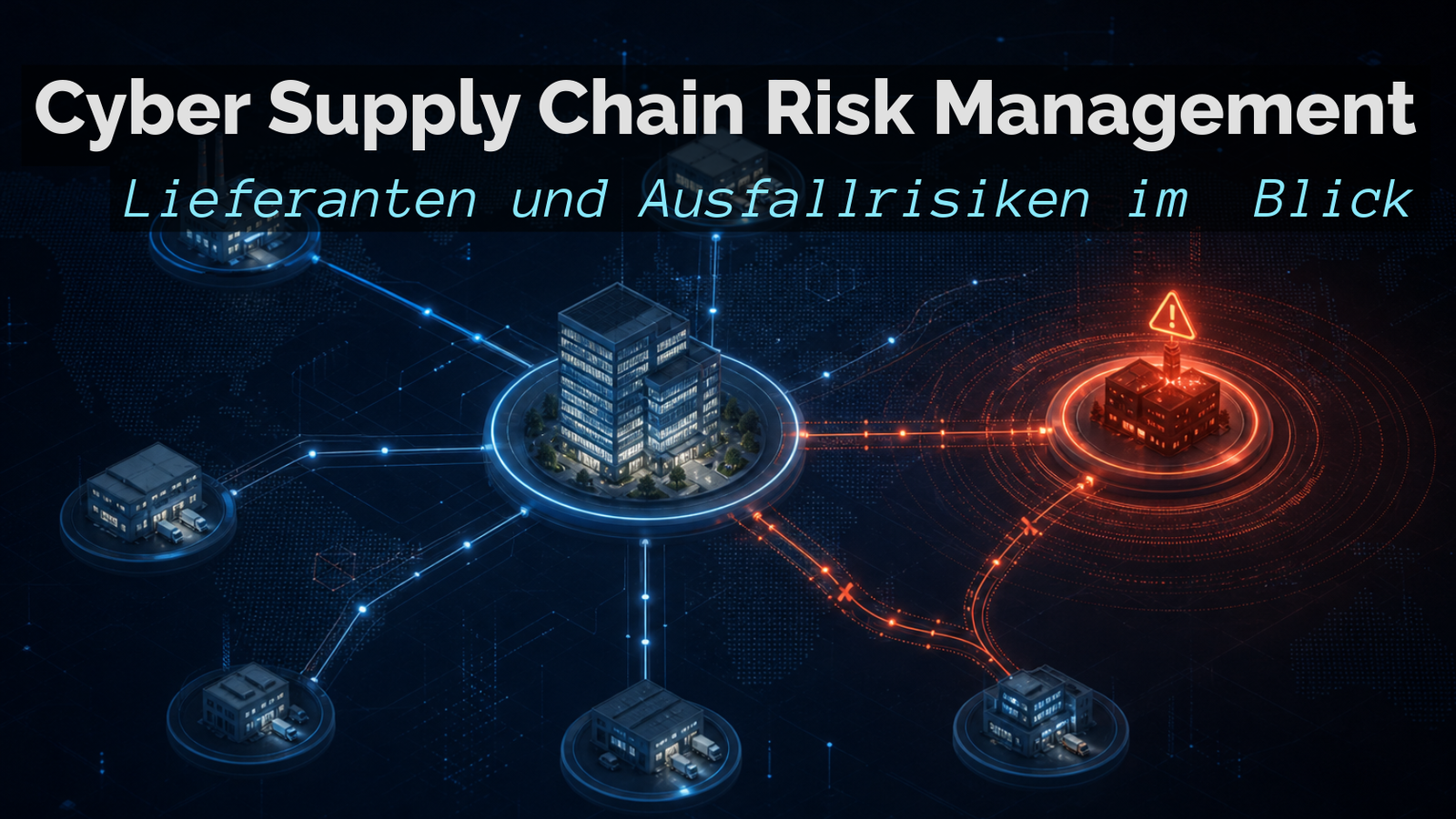
Cyber Supply Chain Risk Management: Managing Supplier Outage Risk
Why supplier cyber security is part of your own resilience and how organizations can identify outage risks early.
Published on 9/16/2026
Many organizations assess their suppliers before entering a contract. They ask about certifications, security controls and incident response plans. After that, the relationship is often managed mainly from a commercial perspective. This creates a blind spot: a supplier's cyber security can change long before the next formal review.
The risk is not limited to stolen data. A cyber attack can temporarily disable a service provider, production line, logistics platform or critical communication channel. For the customer, this becomes an outage risk: orders may not be processed, goods may not be delivered and internal operations may not continue as planned.
Cyber Supply Chain Risk Management, or CSCRM, helps organizations make these dependencies visible and manage them appropriately. The goal is not to treat every supplier as an assumed threat. The goal is to understand which digital connections are business-critical, how their risk changes and what would actually stop working if a supplier became unavailable.
Why supplier risk quickly becomes business risk
Suppliers increasingly work directly inside their customers' digital processes. They operate applications, manage cloud environments, deliver software updates, process data or provide interfaces. This creates a shared digital attack surface. An attacker does not have to target the customer directly to create an impact there.
Four types of dependency are particularly relevant:
- Technical dependency: A provider supplies an application, API, network connection or cloud component that a process needs in order to operate normally.
- Operational dependency: A partner performs logistics, billing, support or production. If the partner is unavailable, the customer's process slows down or stops.
- Data dependency: A supplier processes information needed for customers, employees or regulatory obligations.
- Time dependency: A supplier cannot be replaced quickly because of specialist knowledge, approvals or integrations.
The tighter these connections are, the more strongly a supplier incident can affect the customer's resilience. Whether the cause is ransomware, a compromised account, a misconfiguration or infrastructure failure, the immediate business question is whether a critical process can continue.
Outage risk instead of an abstract risk score
A standardized assessment creates a common basis for communication between supplier and customer. A risk score condenses multiple technical signals into a traceable view of the supplier's external security posture and can show how risk changes over time.
When a customer and a supplier discuss the risk score, it provides an impression of cybersecurity without directly disclosing all data. The customer then places the score in the context of its own processes. Factors relevant to this include, among others, the supplier’s criticality, substitutability, the data involved, and the tolerable downtime. While a risk score does not directly answer the question “What happens if this supplier is unavailable tomorrow?”, it does make it easier to assess how vulnerable a process associated with a supplier is. A moderate risk may be acceptable for a non-critical service. The same score, however, could represent a significant risk of downtime for a critical production or payment service. Therefore, the assessment of supplier risk should combine two perspectives:
- Cyber perspective: Which internet-facing systems, vulnerabilities, misconfigurations and indicators are visible at the supplier?
- Business perspective: Which processes, products, customer experiences and obligations depend on this supplier?
Only the combination makes prioritization possible. A supplier with few externally visible assets may still be critical if those assets provide a central interface. Conversely, a technically noisy supplier is not automatically the most urgent business threat if a robust replacement process exists.
Why a one-time supplier review is not enough
Supplier environments change continuously. New subdomains, cloud services, certificates and interfaces appear. Systems are migrated, test environments remain reachable and responsibilities move between teams. These changes can influence a standardized assessment or risk score even when the underlying technical details are not disclosed to customers.
A one-time questionnaire mainly documents a point in time. It records what the supplier reported and which evidence was available then. It does not reliably show whether new systems have become exposed, a certificate has expired or a critical interface is now operated differently.
Continuous external observation complements these measures, such as audits and contracts reviews, by providing an independent outside perspective: which changes could influence the supplier's standardized assessment? The underlying technical signals – such as new subdomains, internet-facing services, certificate issues or known vulnerabilities – do not have to be disclosed to the customer in detail. A risk score, its trend and suitable supporting evidence may be the right level of information for the supplier relationship.
Signals that may indicate increasing supplier risk
Not every technical signal is a security incident. Several changes together can justify a focused discussion with the supplier. Examples include:
- newly discovered subdomains, IP addresses or internet-facing services without a known business purpose,
- exposed administration or remote access interfaces,
- outdated software or known vulnerabilities on internet-facing systems,
- expired, misassigned or unexpectedly changing certificates,
- unusual changes to DNS, email security controls or cloud endpoints,
- a growing number of unknown or apparently unmanaged systems, and
- recurring findings that remain unresolved or unexplained over time.
All of this has to be factored into the risk score. Combined with ongoing monitoring, this provides an indication of how well a supplier manages its external attack surface.
From monitoring to actionable supplier governance
Monitoring only creates value when it leads to decisions. A practical approach consists of five steps:
- Prioritize suppliers: Rank providers by process dependency, data access, replaceability and potential outage duration.
- Map digital dependencies: Assign domains, interfaces, portals, cloud services and external access paths to suppliers and business processes.
- Observe changes: Detect new or changed external assets regularly and compare them with known information.
- Assess findings together: Procurement, business owners, IT, security and the supplier clarify relevance, ownership and deadlines.
- Prepare recovery: For critical dependencies, define alternative paths, communication chains and acceptable recovery times.
A critical finding should not remain only with the security team. It should be linked to a supplier, a contract, an owner and a concrete deadline. Only then can visibility turn into risk reduction.
Questions organizations should ask suppliers
A standardized assessment is most valuable when it leads to better conversations. Depending on criticality, organizations can ask:
- Which standardized assessment or risk score is provided, how often is it updated and how are relevant changes reflected?
- Which supporting evidence or explanation is available when the score changes materially?
- Which internet-facing systems and interfaces support our service?
- Who owns these systems and how are changes documented?
- How are critical security findings assessed and within what time are they remediated?
- What processes apply if a system or interface becomes unavailable?
- How will we be informed about a cyber incident, prolonged disruption or relevant change?
- Which dependencies exist on subcontractors or cloud providers?
These questions make cyber security part of the supplier relationship. They also help align contractual requirements, escalation paths and recovery exercises with the actual dependency.
What good preparation for a supplier outage looks like
Monitoring cannot prevent every outage. Its value also lies in how quickly an organization can respond. For critical suppliers, it should be clear which services must continue during degraded operations, which data must remain available and who decides on escalation and alternative measures.
Resilience often starts with transparency: an up-to-date list of critical dependencies, a reachable contact, a defined communication template and a realistic recovery-time estimate. Where an outage is unacceptable, technical and organizational alternatives should be assessed as well.
Conclusion: supplier cyber security is part of your resilience
An organization cannot fully understand its own digital attack surface if it ignores the external dependencies of its suppliers. A provider does not have to be fully compromised for an outage to become the customer's business problem. It is enough that a critical process is no longer available.
Those who monitor their suppliers’ cybersecurity help ensure the availability of their own processes.
Cyber Supply Chain Risk Management therefore connects supplier governance, external visibility and business continuity. The first step is a reliable overview: which suppliers are critical, which digital connections exist and which changes would require a fast response?