
IEEE qCCL 2026
Robustness of Quantum Machine Learning: Learnings from IEEE qCCL 2026 in Aalborg
Published on 7/6/2025
The practical application of Quantum Machine Learning (QML) faces fundamental challenges in today’s NISQ era (Noisy Intermediate-Scale Quantum). In addition to targeted adversarial attacks, device-specific noise in quantum hardware represents a major obstacle.
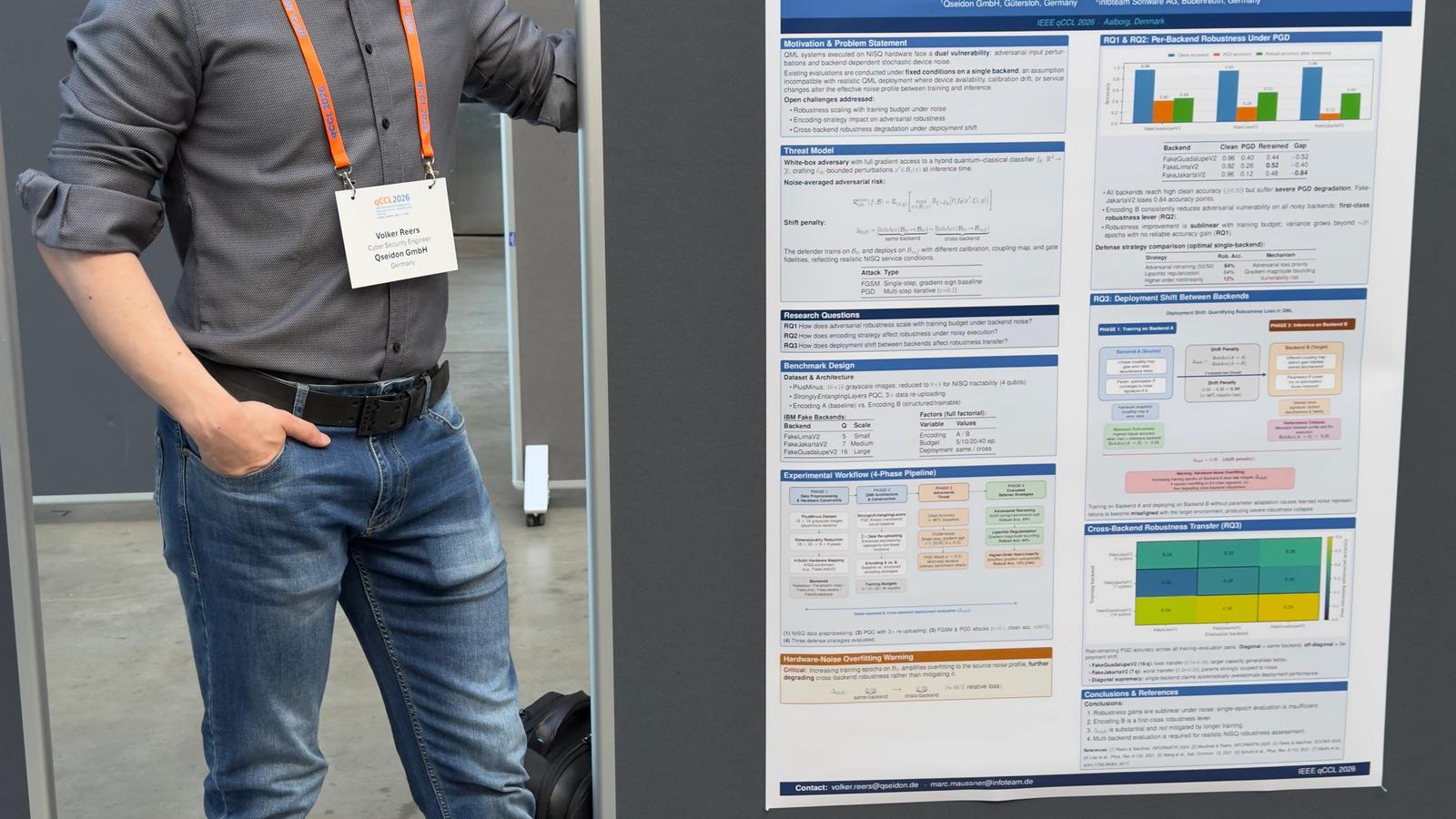
At this year’s IEEE Conference on Quantum Control, Computing and Learning (qCCL) in Aalborg, Denmark, Marc Maußner and I had the opportunity to present our latest research findings on this topic. In our paper and accompanying poster presentation entitled “A Threat-Model-Driven Robustness Benchmark for Quantum Machine Learning Under Device Noise and Deployment Shift”, we introduced a new benchmark framework for evaluating QML robustness.
A New Framework for Real-World Deployment Conditions
Traditional evaluations often focus on white-box attacks such as FGSM (Fast Gradient Sign Method) or PGD (Projected Gradient Descent) under idealized conditions. Our framework goes one step further by systematically examining deployment shift – a scenario in which a QML model is trained on one specific backend but later executed on different hardware.
Our study highlights three key practical findings:
- The impact of deployment shift: If the calibration or topology of the target backend changes during model deployment, mismatched noise profiles can lead to a significant drop in model robustness.
- The risk of hardware-noise overfitting: Longer training on the original source backend does not solve the problem. On the contrary, the model can overfit to the specific noise characteristics of the training hardware, further reducing performance when transferred to a different device.
- Encoding as a line of defense: Choosing the right encoding strategy proves to be an effective lever. Structured or trainable approaches can significantly improve robustness against noise without compromising accuracy on noise-free data.
Insights from the Quantum Community
Beyond our own presentation, the conference provided valuable insights into the current momentum of quantum research. The presented work ranged from advances in Quantum Error Correction at the nanosecond scale to Quantum State Denoising and the optimization of Entanglement Routing in quantum networks.
The insights gained at qCCL are directly feeding into our ongoing research and development activities, helping us build security and machine learning architectures that remain robust in the quantum era.